


Professional Pasta - Pasta Technologies - The press

© G.Mondelli Studio - Italy

THE PRESS

This unit usually includes the following functional groups:

  • raw material and ingredient doser

  • mixing unit

  • dough kneading machine

  • extruder

  • die


  • The raw material and ingredient doser

    The dosing group has to provide the mixing and the dough-making units with the raw materials (and any other additional ingredient) precisely, continuously and in the required quantity. Since pasta basic raw materials are flour (semolina or flour) and liquids (water), each dosing group is in fact made up of separate dosing units.  
     
    Among the usually added ingredients, egg emulsion comes first, but other powdered products are used as well (dehydrated vegetables, food additives or powered eggs).
    The dosing group has therefore to guarantee (besides precision) a steady synchronization between the different operating parts.
    Ingredients can be measured out referring to their volume (volumetric doser), to their weight (gravimetric doser) or in combined sequences.
    Each press builder installs the dosing group that best suits the technological and functional characteristics of this unit, with special concern to mixing raw materials, to making the dough, as well as to the time required for each step and to the production capacity of the press.
    The raw material and ingredient dosing has to take into account their current characteristics (moisture, temperature, etc.), the kind of pasta to be produced, the drying technology the plant is built for.


    The mixer

    It is very important that the solid (flours, powders) and the liquid (water, emulsions) are mixed thoroughly even before the dough making process. This operation is particularly critic for the flour particles (durum wheat semolina or soft wheat flour). If all the single particles don't absorb the liquids in the same way or don't reach the same degree of absorption all at the same time, it will hardly be possible to obtain a thoroughly homogeneous dough and the dry pasta will easily show more or less marked faults (white spots, for instance).


    The dough making unit

    In order to obtain an even and homogeneous absorption of the liquids (water and/or egg emulsion) by the flour particles (semolina and/or flour), at least two basic conditions have to be guaranteed:

    1. the particles must have the same size or average size ranging between not too distant minimum and maximum values (granulometry);

    2. the time needed for the liquid to be absorbed by the particles has to be evaluated while taking into account their average size and the temperature of both flour and liquid. The lower the flour temperature (semolina and flour), the higher has to be that of the liquids used in the dough (water and/or egg emulsion).

    New systems have recently been developed which are able to carry out the dough making in a very short time (about 2-3 minutes), instead of the 12-20 minutes needed for the "normal" dough preparation with traditional kneading machines. A very short dough making time increases considerably the line production speed, since it can better match the speed of the following steps (pre-drying, drying, stabilization), speed that has been dramatically increased in the pasta production modern technology. For this very same reason, at present, fine granulometry flours (semolina and/or flour) are preferred, since it is optimum for short dough making times and at the same time it is more likely to give a final product which doesn't show faults due to flour/water mixing and dough-making anomalies. A quick dough making also allows reduction in the press size (output capacity being equal), and consequent better plant compactness and smaller dimensions.
    During the dough forming, the contact with atmospheric oxygen would increase the enzymatic activities and therefore alterations, especially in the product colour (greyish shade and lost of the yellow colour due to oxidation of natural pigments in semolina). In order to avoid this, the kneading phases, and, for some manufacturers, also the mixing, are carried out in vacuum. The vacuum is obtained throughout systems that may differ from a manufacturer to another (capsulism or others).


    The extruder

    The final dough is extruded in the extrusion unit, consisting of a cylinder inside which a special extrusion screw turns. The screw rotation pushes the dough towards the head press on which a die is set. The pressure on the dough makes it go through the openings in the die and get the required product shape.
    The dough extrusion is a complicated process that causes risk situations for both the product and the extrusion unit.
    This occurs because:

    1. the pressure values are necessarily high (on average 100-120 bar), and this can cause a mechanical stress to the dough, damaging its texture;

    2. the friction caused by the turning screw and the compression values produce dough heating that, if not kept under safety limits (usually <40°C), can cause thermal stress to the dough itself;

    3. the heavy mechanical stress under which the extrusion unit is kept (cylinder, screw, head and their respective supports) requires control and safety devices to be accurate and timely. All manufacturers use extruder automatic locking devices that stop the unit in case the functioning values should exceed the safety standards (pressure, temperature, absorbed power, etc.).

    The heat generated in the dough, due to compression and mechanical friction, can be eliminated by forcing water circulating into a jacket wrapping the extrusion cylinder.
    Moreover, the solutions adopted to reduce mechanical friction to the minimum (cylinder internal lining, screw profile, etc.) are however very important. The head on which the die is installed must also be checked in temperature and pressure. During the press starting phase, a head pre-heating is often needed in order to ease the dough flowing through the die distribution area and to bring the die at working temperature.


    The die

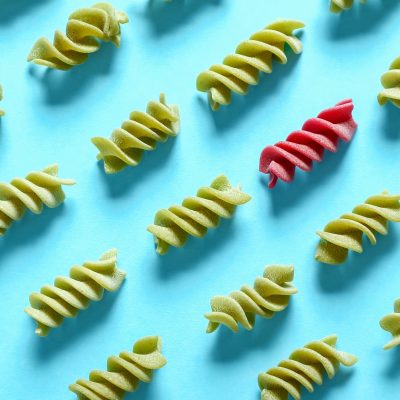
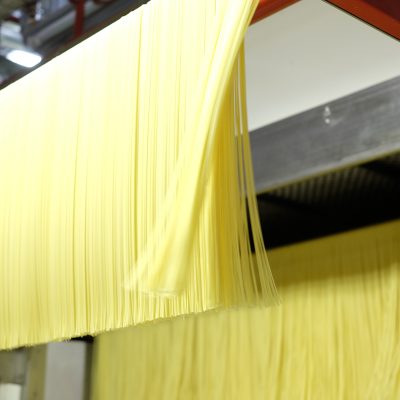
    The die function is to give the product the chosen shape. The great variety of pasta kinds and sizes is due to the possibility of making specific dies. The long cut pasta, for instance, is produced in many different shapes that can be summarized, according to their section, as follows:

    • long round pasta without hole (e.g. spaghetti);

    • long round pasta with hole (e.g. bucati, ziti, zitoni);

    • long oval pasta (e.g. linguine);

    • flat straight pasta with rectangular section (e.g. fettuccine);

    • flat straight pasta with simple (on one side) or double (on both sides) festoons (e.g. mafalde, curly lasagna).

    The dimensions of these shapes (section, diameter, length, width, thickness) can vary from a producer to another, even if many shapes have standard commercial values.
    The die is made of a bronze support with a shape which is usually rectangular for long cut pasta and round for the short one. In the bronze support (that must have the right thickness to give it the necessary strength for the high and continuous pressure it is subjected to), there are holes in which inserts are placed.
    The inserts are designed and patterned so as to give shape to the product. Both the die and the inserts have to be built with extreme precision and made of special materials (e.g. Teflon) able to assure not only the die life but also its efficiency, with concern to both the product quality (even surface, colour, etc.) and the press output capacity.
    The dies made entirely in bronze, directly holed by profiles suitable for the required shapes, are still used for rough surface pasta. Their average life is though considerably shorter than that of Teflon insert dies and are therefore used mainly for small special productions.
    The die is fitted to the press head by devices that have to guarantee the necessary tightness and, at the same time, to allow the die change through simple and quick operations. Each manufacturer applies a die change device suitable for the kind of press he produces, according to the mechanical and constructive features of head and press.
    Since the dies for medium or high production presses have a remarkable weight, these devices imply the use of hoists which allow not only to bring the die at the head height, but also to position it ready for its final locking. These devices have also to guarantee the highest safety for the personnel.


    dry pasta technology