
Macaroni Crates
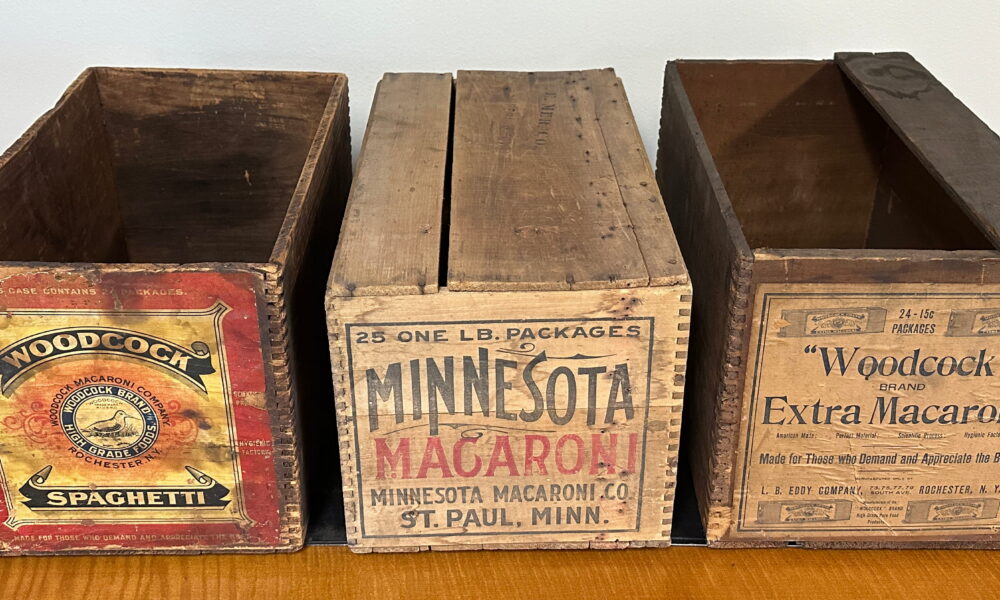
The macaroni crate may look rustic at first glance, but upon deeper examination, one could see it was filled with purpose. An essential ingredient of any crate was to deliver a specific amount of finished product to the customer in good condition at an economical cost.
To accomplish this, a company must have a well-designed and constructed crate that assembles easily. Additionally, to really stand out in a crowded field, a company must have a crate that was memorable and could attract customers to the product. Companies accomplished this through graphics, a key part to building a brand and earning repeat customers.
In the early 20th century, packaging was one of the more labor-intensive parts of a macaroni factory. Factories received wooden crates in unassembled, pre-made pieces, bundled in what were called “shooks”. Workers would assemble the crates by hand or using a “box machine” that could drive several nails into the box automatically at one time. Pasta was typically wrapped in one-pound individual packages, about two dozen of which were placed in a crate.
Subscribe to the magazine to read the full article
Other Articles

Global Food Forum 2026